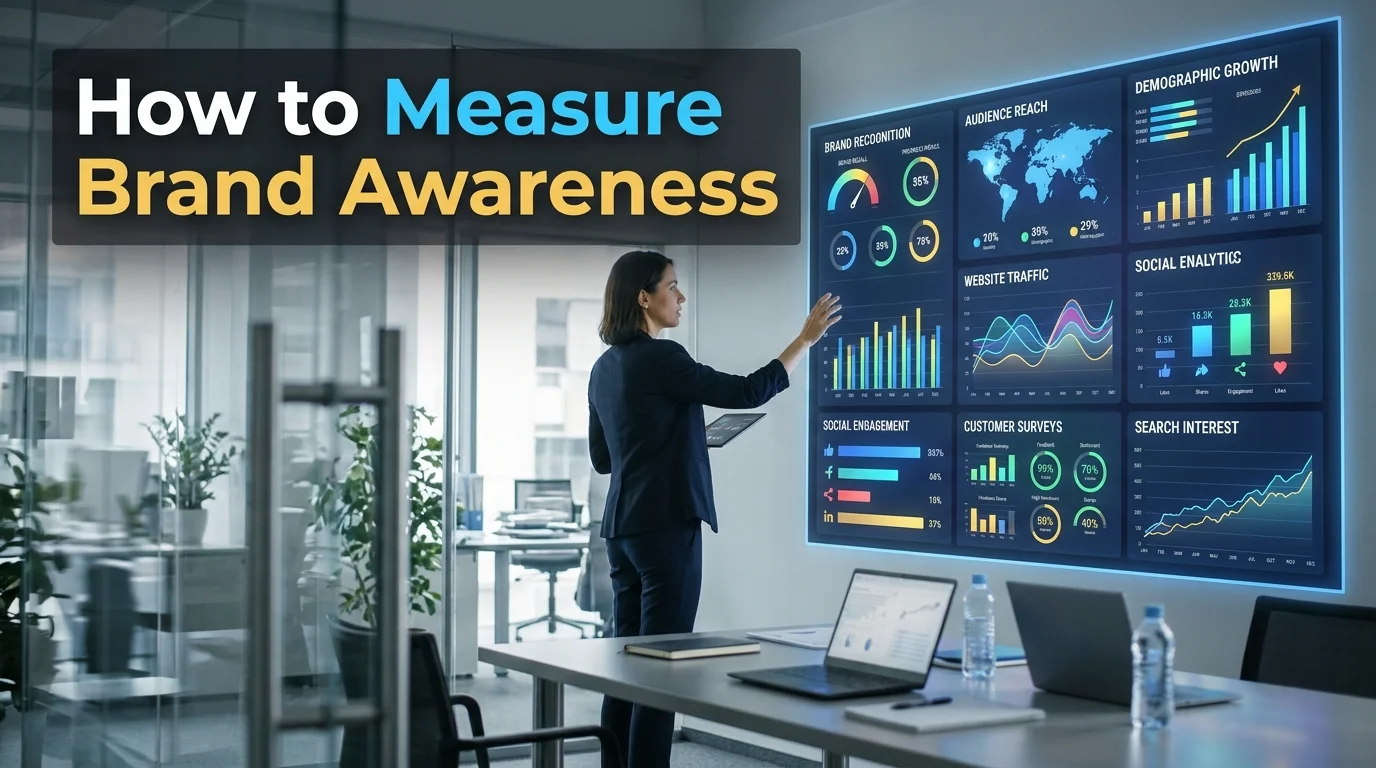
How to Measure Brand Awareness shows whether your target audience remembers, recognizes, and notices your company. The strongest approach combines direct survey research with behavioral signals from search, traffic, social media, and earned coverage. Tracking the same metrics repeatedly also reveals whether marketing campaigns create lasting gains.
Direct answer: To measure brand awareness, track unaided recall, aided recognition, branded search, direct traffic, social mentions, and share of voice. Use consistent surveys as your primary measurement method. Compare results over time and against relevant competitors to identify meaningful changes.
| Measurement | What It Shows | Useful Data Source |
|---|---|---|
| Unaided recall | Whether people remember your company without help | Audience surveys |
| Aided recognition | Whether people recognize your name or logo | Audience surveys |
| Top-of-mind recall | Which company people remember first | Audience surveys |
| Branded search | Whether people actively search for your company | Search Console and Trends |
| Direct traffic | Visits from people already familiar with you | Web analytics |
| Social mentions | How often people discuss your company | Social listening tools |
| Share of voice | Your visibility compared with competitors | SEO, PR, and social tools |
| Earned coverage | Independent media attention | Media monitoring tools |
Why Measuring Awareness Requires More Than One Metric
Awareness happens in people’s minds, so no website metric can capture the entire picture. Someone may know your company without visiting your website or following your social accounts. Surveys therefore provide the clearest direct evidence of recognition and recall.
Digital signals still matter because they show how familiarity affects real behavior. Branded searches, direct visits, mentions, and engagement can reveal changes between survey periods. Using both approaches creates a more dependable measurement system.
This distinction prevents a common reporting mistake. A large increase in impressions does not automatically mean people remember the company. Impressions measure exposure, while surveys can determine whether that exposure became memory.
How to Measure Brand Awareness in 8 Practical Steps
1. Define the Audience You Want to Measure
Start by defining exactly whose familiarity matters to your business. Your audience might include U.S. consumers, business buyers, local customers, or a specific industry segment. Clear audience boundaries make later comparisons more meaningful.
Avoid surveying only current customers when estimating market-level recognition. Existing customers already know your company, creating obvious sampling bias. A representative target-market sample gives you a better baseline.
Keep those audience rules stable across future studies. Changing geography, age groups, screening requirements, or buyer profiles can distort trend data. Consistency makes changes between survey waves easier to trust.
2. Measure Unaided Recall First
Unaided recall asks people to name companies within a category without giving them possible answers. For example, ask which project-management companies come to mind first. Record whether participants mention your company spontaneously.
Always ask this question before showing logos or company names. A prompted list can influence later answers and make recall appear stronger. Current research guides consistently recommend preserving this order.
Calculate the percentage by dividing spontaneous mentions by total respondents. Tracking that percentage over time shows whether your company becomes easier to remember. You can also record which competitors appear most often.
3. Track Top-of-Mind Recall
Top-of-mind recall focuses on the first company someone names within a category. This metric is stricter than total unaided recall. It can reveal which businesses occupy the strongest mental position.
Calculate it using respondents who name your company first. Divide that number by the total survey sample, then multiply by 100. Use the same question wording during every measurement period.
This metric becomes especially useful in crowded U.S. categories. A company may have reasonable recognition without being the first choice people remember. That gap can help marketers diagnose a memorability problem.
4. Measure Aided Recognition

Aided recognition asks whether people recognize your company after seeing its name or logo. Show your company alongside several genuine competitors. Randomize the order whenever possible to reduce position bias.
Recognition normally exceeds spontaneous recall because respondents receive a prompt. That difference is useful, not problematic. Strong recognition with weak recall may mean people know you but rarely think of you on their own.
Calculate aided recognition using the same percentage method. Divide recognized responses by total responses and multiply by 100. Track both recognition and spontaneous recall rather than combining them into one number.
5. Monitor Branded Search Demand
Branded search measures people actively looking for your company, products, or branded terms. Google Search Console can reveal queries sending search traffic to your website. Google Trends can also help compare interest patterns over time.
Look for sustained movement rather than isolated spikes. Public relations coverage, advertising, viral posts, or seasonal demand can temporarily increase searches. Comparing several months provides better context.
Search activity remains a supporting signal rather than a complete measure of awareness. It only captures people who took the extra step of searching. People familiar with your company may never appear in this dataset.
NewsParq readers building an organic acquisition strategy can also review its article on SEO strategies for an online business. Monitor search visibility and branded demand separately. Together, they provide useful context for broader marketing performance.
6. Watch Direct Traffic and Referral Patterns
Direct traffic can indicate visits from people who already know your website or company. Track its trend inside your analytics platform rather than treating one month’s total as proof. Campaign activity can affect direct visits in several ways.
Referral traffic adds another useful signal. An increase from news sites, blogs, creators, or industry publications may indicate growing exposure. Check which sources contribute that traffic before drawing conclusions.
Traffic data can support survey findings but cannot replace them. Analytics platforms classify some direct visits imperfectly. Focus on repeated patterns across several data sources.
A strong website also helps turn familiarity into deeper engagement. NewsParq’s website design tips cover usability, calls to action, and content presentation. Those elements matter after awareness produces a visit.
7. Measure Social Mentions and Share of Voice
Social listening tracks how frequently people mention your company without relying on your own posting activity. Separate organic mentions from reactions to paid campaigns when possible. Also review sentiment and context instead of counting mentions alone.
Share of voice compares your visibility with selected competitors. A simple formula divides your mentions by all tracked category mentions. Multiply that result by 100 to create a percentage.
Set clear competitor and channel rules before comparing periods. Adding major competitors later can change the percentage without any real decline. Stable definitions make the metric far easier to interpret.
If social channels are important acquisition sources, NewsParq’s social media marketing guide provides additional ideas for audience targeting and engagement. Those activities can then be evaluated with the measurement framework above.
8. Build a Repeatable Tracking Schedule
One measurement creates a baseline, while repeated measurements create a useful trend. Quarterly surveys can work for many businesses with moderate campaign activity. Faster-moving brands may choose monthly tracking when budgets permit.
Keep your questionnaire, audience definition, sampling approach, and scoring rules consistent. Otherwise, methodological changes can look like changes in market familiarity. Document every adjustment when a change becomes unavoidable.
Pair survey waves with a monthly dashboard of supporting metrics. Include branded searches, direct traffic, mentions, earned coverage, and competitive share. This structure helps your team notice changes before the next survey.
Which Brand Awareness Metrics Matter Most?
The most important metrics depend on what you need to learn. Unaided recall tells you whether people remember you independently. Aided recognition shows whether they know you after receiving a prompt.
Top-of-mind recall helps measure category salience. Branded search and direct traffic show behaviors linked to existing familiarity. Social mentions and share of voice add competitive and conversational context.
Do not force these signals into one artificial score unless your methodology has a clear purpose. Separate metrics often explain more than a blended number. They can show whether a problem involves reach, recognition, memorability, or engagement.
Example of a Simple Awareness Scorecard
Imagine a U.S. software company surveys 500 qualified buyers each quarter. During its first study, 50 respondents mention the company without prompting. That produces 10% unaided recall.
Suppose 20 respondents name it first, producing 4% top-of-mind recall. Another 175 respondents recognize it from a randomized list, producing 35% aided recognition. These figures create a baseline rather than a universal benchmark.
Three months later, the company should repeat the same study. It can then compare changes with branded searches, direct visits, mentions, and campaign activity. The combined evidence offers much stronger insight than follower growth alone.
Common Measurement Mistakes to Avoid
The first mistake is treating impressions as proof of memory. Advertising platforms can tell you how often content appeared. They cannot confirm whether viewers remember the company afterward.
The second mistake is changing survey questions between waves. Even small wording changes can influence responses. Keep the questions and sampling method as stable as possible.
The third mistake is relying only on customers or social followers. Those groups already have greater exposure than the wider target market. They can provide useful perception data, but not an unbiased market baseline.
Another mistake is ignoring competitive context. Growth can look positive while competitors grow much faster. Share-of-voice and recall comparisons help reveal your relative position.
How Often Should You Measure Brand Awareness?
Your measurement schedule should reflect campaign activity, budget, and market speed. Quarterly tracking offers a practical starting point for many businesses. Major launches can justify additional studies before and after the campaign.
Digital supporting metrics can be checked more frequently. Monthly branded-search, traffic, and mention reports can highlight short-term movement. Avoid reacting to small weekly changes without broader evidence.
The most important rule is consistency. Repeating the same method produces comparable data. A stable system becomes more useful as historical information accumulates.
Frequently Asked Questions
How to Measure Brand Awareness Without Expensive Research Tools?
You can start with simple surveys and free digital data sources. Google Search Console, Google Trends, web analytics, and social-platform searches provide useful supporting signals. Market-level surveys still require access to suitable respondents for reliable estimates.
What Is the Best Metric for Measuring Awareness?
Unaided recall is one of the strongest direct measures because respondents receive no brand prompt. Aided recognition provides another important perspective because it captures familiarity. Most businesses should track both instead of choosing only one.
Is Website Traffic a Brand Awareness Metric?
Website traffic can support awareness analysis, but it does not directly measure market familiarity. Visitors have already taken an action that nonvisitors have not. Use traffic beside survey results rather than treating it as the primary score.
What Is the Difference Between Recognition and Recall?
Recognition measures whether someone identifies your company after seeing a prompt. Recall measures whether someone retrieves the company from memory without that prompt. Recall therefore represents a harder test of memorability.
Can Social Media Measure Awareness?
Social data can show reach, mentions, engagement, and competitive visibility. These indicators help explain how widely people encounter or discuss a company. They should complement survey-based recognition and recall measurements.
Turn Awareness Data Into Better Marketing Decisions
Good measurement should tell you what to change next. Low recall with reasonable recognition suggests people know the company but do not remember it easily. Weak scores across both measures may point toward insufficient reach.
Compare these findings with channel data before changing budgets. Search growth, media mentions, social activity, and direct visits can help explain where momentum originates. Your goal is consistent evidence, not one impressive dashboard number.
After establishing a baseline, repeat the same process and document the trend. Connect meaningful changes to campaigns, content, public relations, and audience strategy. NewsParq’s guide to promoting a business through email signatures offers another example of a repeatable branded touchpoint.