Miranda rights are warnings that police must provide before conducting a custodial interrogation. They cover the right to remain silent, protection against self-incrimination, and access to legal counsel. Contrary to a common portrayal on television, police do not have to read the warning every time they make an arrest.
Short answer: Police must give the warning before a custodial interrogation. That means a person is in custody and officers ask questions or use conduct they should know is reasonably likely to produce an incriminating response. An arrest alone does not always trigger the warning, and a missed warning does not automatically end a criminal case.
The federal rule generally produces these outcomes:
| Situation | Warning normally required? | Why Miranda Rights Apply |
| Arrested but not questioned | No | Custody exists, but interrogation does not |
| Arrested and questioned about a crime | Yes | Custody and interrogation occur together |
| Routine roadside traffic stop | Usually no | Most ordinary traffic stops are not considered custodial for this purpose |
| Voluntary statement without police prompting | Usually no | Police did not interrogate the person |
| Urgent question about an immediate public danger | Not always | The public-safety exception may apply |
What the “Miranda Rights” Warning Actually Protects
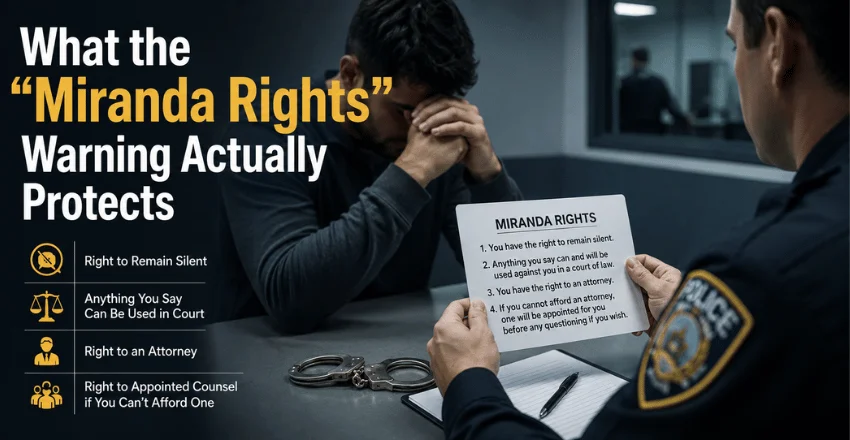
The Miranda Rights established by the Supreme Court’s 1966 decision in Miranda v. Arizona include four core warnings: the right to remain silent, the warning that statements can be used in court, the right to an attorney, and the right to appointed counsel if the person cannot afford one.
These safeguards protect the Fifth Amendment privilege against compelled self-incrimination during custodial questioning. The warning requirement is therefore tied to a particular type of police interaction, not every conversation with an officer.
Readers exploring other legal subjects can also browse NewsParq’s law coverage.
When Miranda Rights Apply: Custody Plus Interrogation
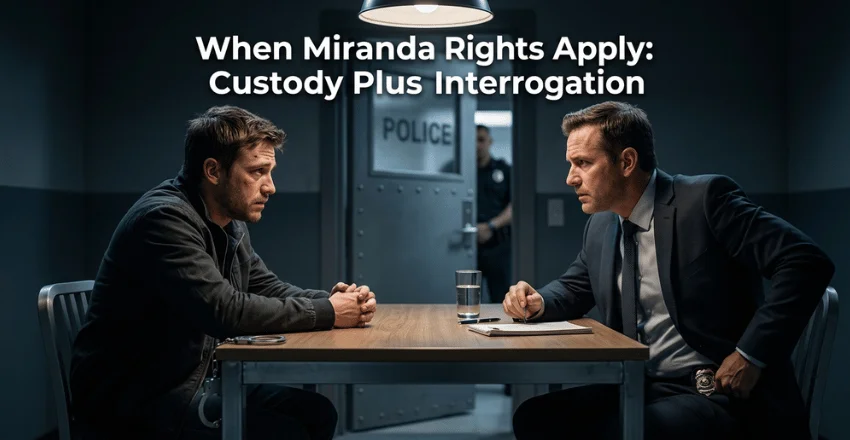
Two conditions normally have to exist at the same time: custody and interrogation. The custody inquiry asks whether a person’s freedom has been restricted to a degree associated with formal arrest. A temporary detention does not automatically satisfy that test.
Interrogation includes direct questions and their “functional equivalent.” This means the rule can also apply to police words or conduct that officers should know are reasonably likely to produce an incriminating response.
This distinction explains why an ordinary traffic stop usually does not trigger the warning immediately. A stop can qualify as a Fourth Amendment seizure without becoming Fifth Amendment custody for interrogation purposes. The circumstances can change, however, if the detention becomes comparable to a formal arrest.
7 Rules to Know Before You Speak
- Custody alone is not enough. Police may arrest someone without asking investigative questions. The warning becomes critical when custody is combined with interrogation.
- The warning must communicate four basic protections. Police must explain the right to remain silent, the possibility that statements can be used in court, access to an attorney, and the right to appointed counsel for a person who cannot afford one.
- Police do not need to use one exact script. The Supreme Court has not required identical wording nationwide. The language must reasonably communicate the required protections.
- A spontaneous statement is different from an answer to interrogation. If police did not question a person or use the functional equivalent of questioning, the custodial-interrogation safeguard may not apply to the statement.
- Immediate public safety can create an exception. Courts have recognized a public-safety exception that may allow unwarned questioning when officers are responding to an immediate danger.
- Invocation should be clear. Courts generally require an unambiguous invocation of the right to remain silent. After a valid waiver, an ambiguous comment about getting a lawyer may not require officers to stop questioning.
- A missed warning usually affects evidence, not the entire prosecution. An unwarned statement obtained during custodial interrogation may be excluded from the prosecution’s case-in-chief. Other lawfully obtained evidence can remain available.
What Happens If Police Skip the Warning?
Failure to give the warning does not automatically make an arrest unlawful or require dismissal of the charges. The main issue is usually whether prosecutors may use the resulting statement. A court examines the circumstances when deciding a suppression motion.
The evidence issue can become more complicated when investigators discover physical evidence because of an unwarned statement. In some circumstances, physical evidence obtained through a voluntary but unwarned statement may still be admissible. A genuinely coerced statement raises separate constitutional concerns. You might also like Exclusionary Rule.
A violation of the warning requirement alone also does not automatically create a civil claim for damages under federal law. Courts distinguish the procedural safeguard created by the Miranda rule from an automatic violation of the Fifth Amendment itself.
A June 22, 2026 Supreme Court ruling, McCarthy v. Hernandez, addressed confession procedures, jury instructions, and federal habeas review. It did not replace the basic custody-plus-interrogation framework explained above.
Students following constitutional cases may also find NewsParq’s article on selecting a law assignment topic useful for broader legal research.
How to Invoke Silence and Ask for a Lawyer Clearly

Courts place significant weight on clear language when a person wants to stop questioning. A person who wishes to remain silent should state that decision directly. Someone who wants legal counsel should also make that request clearly.
Plain statements such as “I am invoking my right to remain silent” and “I want a lawyer before answering questions” communicate the request directly. No special ceremonial words are required. If a real investigation is involved, individualized advice should come from a licensed criminal-defense attorney.
What to Do Next
If police questioning may affect a real criminal case, write down what happened while the details are still fresh. Speak with a licensed criminal-defense lawyer in the relevant state as soon as practical. State constitutions, statutes, and court decisions can provide protections beyond the federal baseline.
Frequently Asked Questions
No. An arrest without interrogation does not automatically require the warning at that moment. The federal safeguard generally applies when police conduct a custodial interrogation.
Yes. The key issue is custody, not whether handcuffs have already been used. If a person is not in custody for Fifth Amendment purposes, the warning generally is not required before questioning.
Not by itself. A court may suppress an affected statement, but prosecutors can continue the case if other admissible evidence supports the charge. The outcome depends on the facts and applicable law.
Sometimes. Physical evidence derived from a voluntary but unwarned statement may still be admissible in certain circumstances. Coerced statements present a different constitutional issue.
Use direct language rather than hints. State that you are invoking your right to remain silent. If you want legal counsel, clearly say that you want a lawyer before answering questions.