
Massachusetts unemployment insurance provides temporary income to eligible workers who lose a job or have their hours significantly reduced through no fault of their own. As of September 2026, eligible claimants can receive up to $1,105 per week for up to 30 weeks, depending on previous wages and individual circumstances.
Losing a job can raise immediate questions about income, health coverage, bills, and how quickly you can find another position. Unemployment benefits in Massachusetts can provide temporary financial support while eligible workers look for employment, but filing the initial application is only the first step. Claimants also need to understand weekly certifications, work-search requirements, payment rules, and deadlines that could affect their benefits.
The state’s unemployment system has also changed in ways that make older online guides unreliable. Claimants now use Unemployment Services for Workers through a MyMassGov account rather than the former UI Online login, and the Department of Unemployment Assistance has updated several processes around weekly claims and work-search reporting. This guide explains the current rules and reviews Massachusetts’ latest unemployment rate and labor-market conditions.
Massachusetts Unemployment at a Glance
| Item | Current information |
|---|---|
| Latest statewide unemployment rate | 4.4% in July 2026 |
| U.S. unemployment rate in July 2026 | 4.1% |
| Maximum weekly UI benefit | $1,105 |
| Maximum current benefit duration | Up to 30 weeks |
| Minimum earnings listed for basic eligibility | At least $6,300 over the last 12 months |
| Weekly work-search requirement | At least 3 activities |
| Waiting week | First eligible claimed week is unpaid |
| DUA claimant call center | 877-626-6800, Monday to Thursday, 8:30 a.m. to 4:30 p.m. |
| Weekly TeleCert line | 617-626-6338, daily 6 a.m. to 10 p.m. |
These figures reflect information available from Massachusetts agencies in early September 2026, so applicants should verify benefit amounts when filing. The weekly maximum can change over time, and monthly unemployment statistics are revised as new labor-market data becomes available. Massachusetts is scheduled to release its August 2026 state unemployment and jobs estimates on September 18, 2026.
What Is the Massachusetts Unemployment Rate in 2026?
The latest published statewide data puts the Massachusetts unemployment rate at 4.4% for July 2026, unchanged from the revised June rate. The national unemployment rate was 4.1% in July, placing Massachusetts 0.3 percentage points above the national seasonally adjusted rate. Massachusetts’ labor-force participation rate remained at 65.3%, according to the state’s Executive Office of Labor and Workforce Development.
The headline rate does not mean that 4.4% of every Massachusetts resident is unemployed. It measures unemployed people who are in the labor force, meaning they are generally available for work and actively seeking employment, rather than everyone in the population. State data showed the labor force decreased by about 2,700 people in July, including approximately 2,500 fewer people classified as unemployed.
Payroll employment also weakened slightly during July, with Massachusetts recording a preliminary monthly decrease of 4,600 jobs after a revised gain in June. Private Education and Health Services, Other Services, and Professional and Business Services were among the categories showing the strongest month-over-month growth despite the overall decline. Local conditions differed substantially, with unemployment rates rising in 10 of the state’s 12 labor-market areas between June and July.
Who Qualifies for Massachusetts Unemployment Benefits?
A person does not qualify simply because employment ended, because Massachusetts considers earnings, the reason for separation, and whether the claimant remains available for work. The current DUA eligibility page says applicants generally should have earned at least $6,300 during the previous 12 months, earned Massachusetts income, and be legally authorized to work in the United States. A claimant also generally needs to be able to work, available for work, and actively searching for a new position.
Workers who have not completely lost their jobs may still qualify in some situations. Massachusetts specifically says people whose hours have been significantly reduced through no fault of their own should consider applying for unemployment insurance. Eligibility and the amount payable can then depend on the claimant’s remaining wages and other circumstances.
Not every type of earnings can establish an unemployment claim. DUA lists several exclusions, including certain independent contracting or consulting income, self-employment, work-study earnings, some commissions, and certain employment with nonprofit or religious organizations. Because individual cases can be complicated, Massachusetts advises people who are uncertain about eligibility to apply and let DUA make the determination.
Can You Get Unemployment If You Quit or Were Fired?
Being laid off because an employer lacks work is one of the clearest situations in which a worker may qualify, but quitting or being fired does not automatically determine eligibility. Massachusetts says workers fired for reasons that do not involve deliberate misconduct or violations of employer rules may still qualify. Poor job performance, for example, does not automatically disqualify a claimant.
People who voluntarily resign face a different test. Benefits may be available when a worker quits for good cause attributable to the employer or because of circumstances considered urgent, compelling, and necessary under Massachusetts law. DUA examines the specific facts, so it may deny a resignation without a qualifying reason.
Applicants should therefore describe the job separation accurately instead of selecting the answer that appears most likely to produce approval. DUA may ask the former employer for information and can request additional facts from the claimant during its review. Documents such as termination notices, emails, schedules, written complaints, or other employment records can be useful when the circumstances are disputed.
How Much Does Massachusetts Unemployment Pay?
Massachusetts generally calculates a worker’s weekly unemployment benefit at approximately 50% of the worker’s average weekly wage, subject to the state’s maximum. As of September 2026, the official maximum weekly benefit amount is $1,105. Actual payments can be substantially below the maximum because they depend on the claimant’s previous earnings.
The state calculates a maximum benefit credit that limits how much a claimant may receive during the benefit year. That amount is generally the lesser of 30 times the claimant’s weekly benefit amount or 36% of total base-period wages. Dividing the maximum benefit credit by the weekly benefit amount determines how many full weeks the worker can potentially receive, subject to Massachusetts’ current 30-week maximum.
Qualifying claimants who are the main support for dependent children may receive an additional dependency allowance of up to $25 per child per week. A qualifying dependent generally must be under 18, under 24 and enrolled as a full-time student, or older than 18 and unable to work because of a mental or physical disability. Spouses do not qualify as dependents for this unemployment allowance.
How Long Can You Collect Massachusetts Unemployment?
Massachusetts currently allows qualifying claimants to receive regular unemployment benefits for up to 30 weeks, although a worker’s individual benefit calculation may result in fewer weeks. The benefit year remains open for 52 weeks, meaning the maximum weeks of payments can be used within that one-year claim period when the worker otherwise remains eligible. Receiving unemployment for 30 weeks is therefore not guaranteed simply because a claim has been approved.
Massachusetts law can move the maximum between 26 and 30 weeks depending on labor-market conditions. The state reduced the maximum to 26 weeks for certain new claims in July 2023, then returned it to 30 weeks effective for qualifying claims in 2025 as unemployment conditions changed. Applicants should rely on the number of weeks stated in their current DUA claim rather than an older online article.
How to Apply for Massachusetts Unemployment
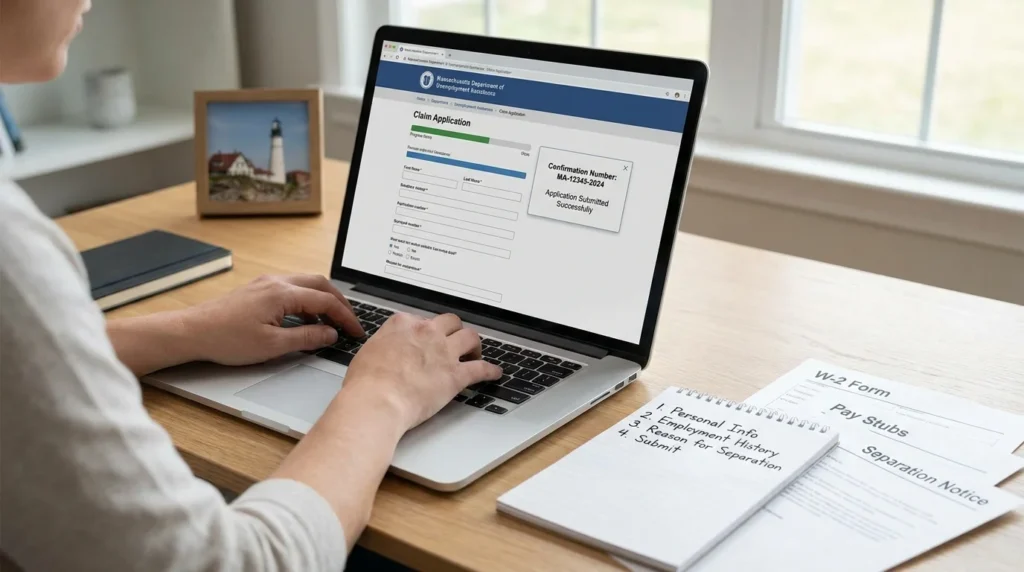
Most people can file fastest through Massachusetts’ current Unemployment Services for Workers system. Applicants need a MyMassGov account, and they can’t use an old UI Online username and password to access the replacement system. DUA advises workers to apply as soon as they become unemployed or experience a qualifying reduction in hours.
Before starting, applicants should gather their Social Security number, contact information, employment history, employer details, and information about why each job ended. Applicants who are not U.S. citizens need documentation showing work authorization, while former military members or federal employees may need additional government employment records. Having these materials ready can reduce delays caused by missing information.
The basic online process is straightforward:
- Create or sign in to a MyMassGov account.
- Open Unemployment Services for Workers.
- Select File an unemployment insurance claim from the dashboard.
- Enter the requested personal, wage, and employment information.
- Review the separation information carefully before submitting.
- Watch for the confirmation message and future DUA notices.
The Massachusetts Department of Unemployment Assistance sets out those six steps in its Massachusetts unemployment application guide, revised in 2026 for the Unemployment Services for Workers system. Claimants with an account can access the Unemployment Services for Workers login instructions for current MyMassGov guidance. The DUA claimant call center is also available at 877-626-6800 from 8:30 a.m. to 4:30 p.m., Monday through Thursday.
What Happens After You Apply?
Applying does not mean benefits begin immediately, because DUA may need to verify wages, identity, job-separation information, or responses from former employers. Some claims remain pending for several weeks while DUA reviews those issues. Claimants should read every notice carefully and respond by any deadline DUA states.
Massachusetts also has a waiting week, which is the first otherwise eligible week for which the worker files a weekly claim. No unemployment payment is made for that first week, so the first payable week is normally the second eligible week claimed. This rule makes it especially important to begin filing weekly claims promptly rather than waiting for the initial application review to finish.
You Must File a Weekly Claim in Massachusetts
An initial application is only the first step because claimants must request benefits each week they need unemployment assistance. Massachusetts instructs workers to start submitting weekly requests the week after applying, even if DUA has not finished reviewing the original application. Missing certifications can delay payments or eventually cause a claim to close.
During each weekly certification, claimants generally confirm that they were able to work, were available to work, and were actively seeking employment. They must report changes in work status or income and provide information about at least three qualifying work-search activities for the week. Job applications, interviews, employer contacts, job fairs, networking events, placement services, and qualifying MassHire activities are examples of activities that can count.
Workers should keep their own record of job-search efforts even though online claimants no longer need to upload the old paper work-search log. DUA can ask for information to verify prior searches, so dates, employer names, positions, contact information, and results are worth keeping. Claimants selected for the federal Reemployment Services and Eligibility Assessment program must also participate as required to maintain eligibility.
Can You Earn Money While Collecting Unemployment?
Working part time does not necessarily end an unemployment claim, but claimants must report income and changes in employment accurately during weekly certification. DUA can adjust the weekly payment based on other income or part-time earnings, and failing to report earnings may create an overpayment or eligibility problem. Claimants should report work when required even when they have not yet received the paycheck for those hours.
People waiting for full-time employment sometimes explore temporary income options, and NewsParq’s guide to earning money without a job offers additional ideas. However, earning side income does not remove the obligation to disclose reportable work or earnings to DUA. Readers managing a period of reduced income can also explore the broader NewsParq Finance section as they plan their next steps.
How to Check Your Claim Status in Massachusetts
Claimants can check both application and payment information through the dashboard in their Unemployment Services for Workers account. Common status labels include Pending, Processing, Waiting Week, Paid, Payment in Progress, and Claim Closed. Massachusetts says a claim can close when benefits have not been requested for three consecutive weeks, although an eligible worker may be able to reopen the claim.
People who cannot get the information they need online can call 877-626-6800 to check an application or 617-626-6563 to check payment status. Once an approved weekly claim has been processed, payments are commonly issued within approximately two business days, although banking and verification issues can cause additional delays. The state’s available payment methods are direct deposit and the DUA-approved U.S. Bank ReliaCard.
Are Unemployment Benefits Taxable in Massachusetts?
Yes, unemployment benefits are taxable income for both federal and Massachusetts tax purposes. DUA does not automatically withhold income taxes, so claimants can elect withholding or plan to pay the tax when filing their returns. The currently listed voluntary withholding rates are 10% for federal income tax and 5% for Massachusetts income tax.
Recipients receive Form 1099-G showing unemployment benefits paid during the year, and they use that information when preparing federal and state tax returns. Claimants can update their withholding election through the Benefit Details area of Unemployment Services for Workers. Keeping benefit and tax records during the year can make filing easier and reduce the risk of an unexpected tax balance.
What If Your Massachusetts Claim Is Denied?
A denial is not necessarily the end of a claim because Massachusetts gives claimants the right to appeal unemployment decisions. The standard deadline is 10 days from the mailing date on the determination letter, so read the notice immediately rather than waiting until the end of the month. Claimants can submit appeals online through Unemployment Services for Workers or by mail.
During an appeal, claimants can provide supporting documents, identify witnesses, request an interpreter, and choose from available hearing formats. A late appeal submitted within 30 days may sometimes be accepted when there was good reason for the delay, while approvals after that period are much more limited. Workers who are still unemployed should continue meeting applicable weekly requirements while the dispute is pending.
Massachusetts Unemployment Phone Numbers and Help
Massachusetts DUA now keeps its main claimant call center open Monday through Thursday from 8:30 a.m. to 4:30 p.m., and uses Fridays to process open claims and respond to requests. You can request weekly benefits through TeleCert at 617-626-6338 from 6 a.m. to 10 p.m. daily. The separate payment-status line is 617-626-6563, while the direct-deposit line is 617-626-6570.
People who need face-to-face assistance can also seek help through DUA’s Boston Re-Employment Center or participating MassHire Career Centers, although appointments may be required. MassHire additionally offers job-search assistance, career-center services, hiring events, training opportunities, and access to JobQuest. Those resources can be particularly useful for workers who need both unemployment assistance and help finding their next position.
The Bottom Line
Unemployment benefits in Massachusetts can replace part of a worker’s lost wages while they search for another job, but continued eligibility requires active participation in the claims process. As of September 2026, the state lists a maximum weekly benefit of $1,105 for up to 30 weeks, requires at least three weekly work-search activities for most claimants, and uses MyMassGov-based Unemployment Services for Workers for online claims. The latest available statewide unemployment rate is 4.4% for July 2026, compared with a 4.1% national rate.
Anyone who has recently lost a job or experienced a significant involuntary reduction in hours should consider filing promptly rather than trying to determine the outcome entirely on their own. After applying, keep filing weekly claims, document job-search efforts, report earnings accurately, and respond quickly to DUA notices. Those simple steps can prevent avoidable delays while Massachusetts determines whether benefits are payable.
Frequently Asked Questions About Massachusetts Unemployment
What is the maximum Massachusetts unemployment benefit in 2026?
The current maximum is $1,105 per week, although individual claimants may qualify for less based on their previous wages. Qualifying dependent children can potentially add up to $25 per child to the weekly payment. Because Massachusetts can update benefit limits, workers filing later should confirm the current figure with DUA.
How many weeks of unemployment can you get in Massachusetts?
The current maximum is up to 30 weeks, but the number available to an individual depends on that person’s maximum benefit credit and weekly benefit amount. Massachusetts law can reduce the maximum to 26 weeks during certain periods of lower unemployment. The benefit duration shown on the claimant’s current DUA account is therefore more reliable than an older online guide.
How many jobs do you have to apply for each week?
Massachusetts requires at least three work-search activities per week for most people collecting unemployment benefits. Those activities do not all have to be traditional job applications, because interviews, employer contacts, qualifying networking events, employment workshops, and certain placement activities can also count. Claimants should maintain enough information to document the activities if DUA asks for verification.
Why is my Massachusetts unemployment claim still pending?
A claim may remain pending while DUA verifies identity, reviews work history, waits for information from a former employer, or investigates another eligibility issue. Claimants should continue submitting weekly claims while an application is under review rather than assuming no action is required. They should also check their account regularly for questionnaires, documentation requests, and response deadlines.
What is the Massachusetts unemployment login?
Current claimants use Unemployment Services for Workers through MyMassGov, not the former UI Online login. People who previously had UI Online accounts must use the replacement system and create or use a MyMassGov account according to the state’s instructions. The same system is used to manage benefit information and file online weekly claims.