Choosing the best fantasy series means finding a world that matches your reading habits. Some readers want a finished trilogy with a strong ending. Others want enormous worlds, deep lore, political conflict, or dozens of books.
Quick answer: Start with Mistborn for accessible modern epic fantasy. Choose The Lord of the Rings for foundational high fantasy. Try The Broken Earth for ambitious literary storytelling, or The First Law for darker characters. Readers wanting years of material should consider Discworld, The Wheel of Time, or The Stormlight Archive.
Fantasy Series at a Glance
| Rank | Series | Best for | Commitment | Status |
|---|---|---|---|---|
| 1 | Mistborn: Original Trilogy | New fantasy readers | Medium | Complete trilogy |
| 2 | The Lord of the Rings | Classic epic fantasy | Medium | Complete |
| 3 | The Broken Earth | Literary and inventive fantasy | Medium | Complete trilogy |
| 4 | The First Law | Grimdark and character work | Medium | Original trilogy complete |
| 5 | Earthsea | Thoughtful, concise fantasy | Medium | Complete cycle |
| 6 | The Wheel of Time | Huge traditional epics | Very high | Complete |
| 7 | Discworld | Humor and flexible reading | Very high | Complete |
| 8 | The Stormlight Archive | Massive modern worldbuilding | Very high | Ongoing |
| 9 | His Dark Materials | Fast, philosophical adventure | Medium | Original trilogy complete |
| 10 | The Realm of the Elderlings | Character-driven long-form fantasy | Very high | Complete |
How These Picks Were Chosen
Current search results favor book recommendations that help readers compare commitment, style, and completion status. Several leading guides now emphasize whether a saga is finished before asking readers to invest hundreds of hours. That approach makes more sense than ranking books by popularity alone.
This list weighs accessibility, storytelling strengths, commitment, and the quality of each starting point. It also mixes foundational works with influential modern choices. That gives U.S. readers several routes into the genre instead of one rigid answer, and you can find more books and culture picks in NewsParq’s entertainment coverage.
1. Mistborn: The Original Trilogy by Brandon Sanderson
Mistborn is the easiest recommendation for readers who want a complete modern epic. It combines a heist structure, political upheaval, and a clearly defined magic system. The original sequence contains Mistborn, The Well of Ascension, and The Hero of Ages.
The trilogy moves faster than many enormous epic sagas. Its central mysteries also develop across all three books rather than feeling disconnected. That balance makes it a practical starting point for adults exploring contemporary fantasy.
Pros
* Complete three-book story * Clear magic rules * Strong plot momentum * Accessible entry into epic fantasy.
Cons
* Explanations of magic can feel detailed * Readers seeking subtle prose may prefer another choice
2. The Lord of the Rings by J.R.R. Tolkien
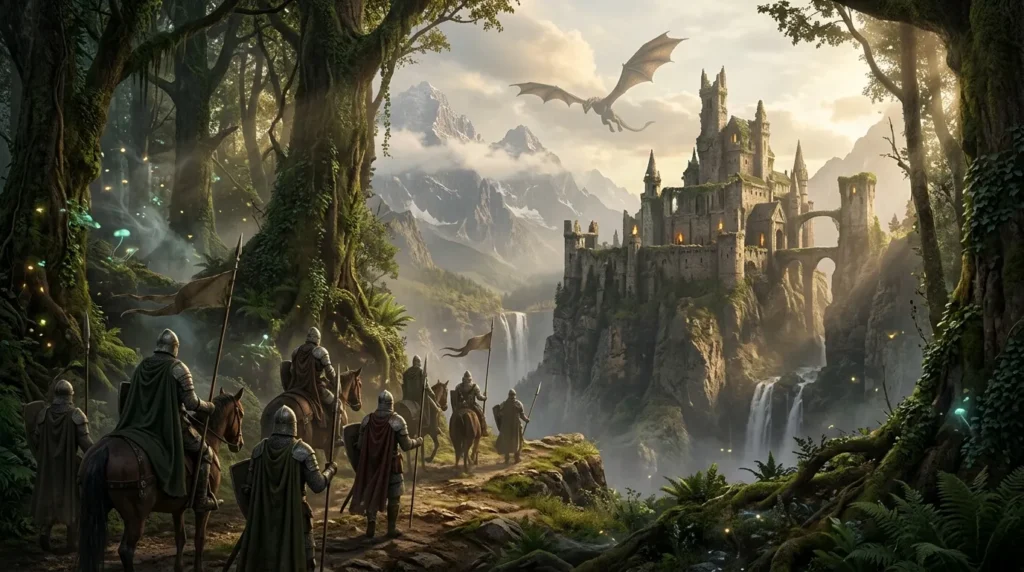
Few works have shaped modern epic fantasy as deeply as Tolkien’s Middle-earth stories. The journey combines friendship, warfare, mythology, temptation, sacrifice, and a vast invented history. Its influence remains visible throughout modern fantasy publishing.
The prose feels more formal than most contemporary novels. Readers comfortable with slower passages often find that rhythm central to the experience. Start with The Fellowship of the Ring, or read The Hobbit first for an easier introduction.
Pros
* Foundational worldbuilding * Fully resolved central story * Rich mythology and history * Strong themes of friendship and courage.
Cons
* Deliberate pacing * Older prose style may challenge some newcomers
3. The Broken Earth Trilogy by N.K. Jemisin
The Broken Earth suits readers wanting something structurally different from traditional medieval fantasy. The trilogy begins with The Fifth Season and builds around catastrophe, power, oppression, and survival. All three novels received the Hugo Award for Best Novel.
Jemisin experiments with perspective and narrative structure throughout the story. Those choices demand more attention than a straightforward adventure novel. The reward is a compact trilogy with unusual ideas and a clear ending.
Pros
* Complete trilogy * Distinctive narrative structure * Strong social and environmental themes * Major critical recognition.
Cons
* Unusual perspective may require adjustment * Dark subject matter can feel intense
4. The First Law by Joe Abercrombie
Readers who prefer morally complicated characters should consider The First Law. The original trilogy includes The Blade Itself, Before They Are Hanged, and Last Argument of Kings. More novels later expand the same world.
Abercrombie focuses heavily on character flaws, power, violence, and unintended consequences. Humor keeps the books from becoming relentlessly grim. The series works especially well for readers tired of spotless heroes and predictable quests.
Pros
* Memorable character voices * Dark humor * Original trilogy is complete * More books are available in the same setting.
Cons
* Brutal violence * Intentionally cynical worldview * First volume emphasizes setup
5. Earthsea by Ursula K. Le Guin
The Earthsea books prove that fantasy does not need thousands of pages to feel profound. Le Guin explores magic, identity, responsibility, mortality, and balance through remarkably focused stories. The cycle spans six principal books beginning with A Wizard of Earthsea.
Her writing favors clarity over spectacle. Major conflicts can be philosophical or personal rather than military. Readers seeking thoughtful fantasy with manageable individual volumes should place Earthsea high on their list.
Pros
* Concise books * Complete cycle * Philosophical themes * Influential approach to magic and identity.
Cons
* Less action-heavy than modern epics * Quiet pacing may not suit every reader
6. The Wheel of Time by Robert Jordan and Brandon Sanderson
The Wheel of Time is designed for readers who want a truly enormous quest. Robert Jordan created the series, while Brandon Sanderson completed the final volumes after Jordan’s death. A Memory of Light is officially listed as book fourteen.
The saga offers a huge cast, layered cultures, magic, prophecy, and long-running character arcs. That scale also creates slower stretches and extensive subplots. Choose it when reading commitment is part of the attraction rather than a drawback.
Pros
* Complete main story * Huge world * Long character development * Traditional epic-fantasy scale.
Cons
* Fourteen main novels * Considerable time commitment * Pacing varies across the sequence
7. Discworld by Terry Pratchett
Discworld is the strongest choice here for readers who want fantasy with comedy and satire. Terry Pratchett wrote 41 Discworld novels across 32 years. The official site also confirms readers do not need to follow one strict order.
That flexibility makes its intimidating book count surprisingly manageable. You can follow characters such as the City Watch or Witches instead. Guards! Guards! is a welcoming starting point for many new readers.
Pros
* 41 novels to explore * Multiple entry points * Comedy with serious themes * Easy to read by subseries.
Cons
* Publication order is not always the easiest route * Early books differ from later installments
8. The Stormlight Archive by Brandon Sanderson
Few modern epics match The Stormlight Archive for sheer scale. Five main novels now form the completed first arc, ending with Wind and Truth. Sanderson plans ten books divided into two five-book arcs.
Each volume is large, and the setting contains extensive history, cultures, magic, and interconnected mysteries. That density rewards readers who enjoy taking notes or discussing theories. It is a poor choice when you want something short and finished.
Pros
* Extensive worldbuilding * First five-book arc available * Detailed magic and lore * Large ensemble cast.
Cons
* Full project remains unfinished * Very long individual books * Steep early learning curve
9. His Dark Materials by Philip Pullman
His Dark Materials blends adventure with questions about authority, knowledge, freedom, and belief. U.S. editions begin with The Golden Compass, followed by The Subtle Knife and The Amber Spyglass. Penguin Random House lists the original sequence as a three-book trilogy.
The books move quickly enough for younger readers while offering considerable depth for adults. Parallel worlds give the story growing scale without requiring ten volumes. It is a strong choice for families or adults revisiting fantasy after years away.
Pros
* Complete original trilogy * Faster commitment * Strong adventure structure * Works for teens and adults.
Cons
* Philosophical themes can be challenging * Later related books expand beyond the original trilogy
10. The Realm of the Elderlings by Robin Hobb
Robin Hobb’s interconnected novels suit readers who prioritize characters over elaborate battle sequences. The broader story follows relationships, political pressures, difficult choices, and their long-term consequences. Its emotional continuity rewards readers who stay with the sequence.
This is a substantial reading project rather than a weekend trilogy. Hobb often favors patient development over constant action. Start with Assassin’s Apprentice and follow publication order for the clearest experience.
Pros
* Deep character development * Long-term emotional payoff * Completed overarching sequence * Multiple connected story arcs.
Cons
* High reading commitment * Frequently slow and emotionally heavy
Best Fantasy Series for Different Readers
The best fantasy series for a beginner is Mistborn because its first trilogy feels modern and manageable. Readers wanting literary experimentation should try The Broken Earth. Fans seeking foundational high fantasy should begin with Tolkien.
Choose Discworld when humor matters most, and choose First Law when you prefer darker characters. Pick Wheel of Time or Stormlight when massive scope is the main attraction. Earthsea works beautifully when you want depth without enormous individual novels.
Should You Start With a Complete or Ongoing Saga?
A complete series gives you certainty about the ending and total commitment. That matters when a reading project may last several months. Recent recommendation pages increasingly highlight completion status for precisely this reason.
Ongoing stories still have advantages because active communities can make each release feel like an event. They also create room for speculation between installments. The tradeoff is accepting that later volumes may be years away.
For most newcomers, a finished trilogy offers the safest first commitment. Mistborn, Broken Earth, and His Dark Materials all provide defined endpoints. After that, longer sagas become easier to judge against your tastes.
How to Choose Your Next Fantasy Read
Start by deciding which reading experience matters most to you. Do not choose solely because a book dominates social media or sales lists. A respected epic can still be the wrong match for your preferred pace.
Use these filters before buying or borrowing your first volume:
* Commitment: Do you want three books or dozens? * Completion: Are you comfortable waiting for future installments? * Tone: Do you prefer hopeful, dark, humorous, or philosophical stories? * Pacing: Do you enjoy slow worldbuilding or immediate action? * Complexity: Do you want extensive lore or a focused narrative? * Character style: Do you prefer heroic leads or morally complicated casts?
U.S. readers can usually sample these books through public libraries before committing to large sets. Digital library services can also make long sagas cheaper to explore. Testing the first volume is often smarter than buying an entire boxed set.
Frequently Asked Questions
What is the best fantasy series for beginners?
The best fantasy series for many beginners is the original Mistborn trilogy. It has modern prose, clear stakes, and a complete three-book arc. Readers wanting something shorter in style can also begin with Earthsea.
Which fantasy saga should I read after Harry Potter?
Try His Dark Materials if you want another accessible story with young protagonists. Choose Mistborn if you want a larger step toward adult epic fantasy. Earthsea offers a quieter option with schools, magic, and personal growth.
What should I read if I liked Game of Thrones?
The First Law is a natural option for readers drawn to moral ambiguity and political conflict. Robin Hobb also writes complicated characters whose choices produce lasting consequences. Neither series simply repeats George R.R. Martin’s approach.
Which option has the biggest reading commitment?
Discworld contains 41 novels, although readers can follow smaller character-based sequences. The Wheel of Time contains fourteen main books and follows one continuous epic. Stormlight also demands substantial time because its individual volumes are exceptionally large.
Is it better to read completed fantasy sagas?
Completed sagas are ideal when you dislike waiting for endings. Ongoing projects can be equally rewarding when discussion and anticipation appeal to you. Your tolerance for uncertainty should guide the choice.
Final Recommendation
Start with Mistborn when you want the safest all-around introduction to modern epic fantasy. Choose Tolkien when you want the genre’s foundational experience, or Jemisin when you want something less traditional. Your ideal series depends more on reading style than any universal ranking.
After choosing your next book, explore more fiction and culture coverage in NewsParq’s Entertainment section. Readers interested in authors and creative work can also visit NewsParq’s Daphne Abdela profile. You can return to NewsParq’s latest stories for new entertainment and culture coverage.